Your Risk Assessment Was Accurate the Day It Was Written
A risk assessment is true the day it is written
The Globally Harmonized System of Classification and Labelling of Chemicals (GHS) is a United Nations framework for classifying hazardous chemicals and communicating those hazards consistently, through standardized labels and safety data sheets (SDSs), across countries. GHS itself isn’t a law; it’s a model that individual countries adopt into their own binding regulations. In the U.S., GHS is implemented through OSHA’s Hazard Communication Standard (HCS), commonly called “HazCom.”
This isn’t a new or in-progress transition. The U.S. adopted its first GHS-aligned HazCom update back in 2012, and every hazardous chemical manufacturer, importer, distributor, and employer covered by HazCom has been required to classify, label, and document chemicals under a GHS-aligned system for well over a decade. What’s changed recently is that OSHA updated HazCom again, to keep pace with newer GHS revisions.
On May 20, 2024, OSHA published a final rule amending the Hazard Communication Standard to align with the 7th revised edition of GHS, plus select elements of the 8th revision. That rule took effect July 19, 2024. It refines classification criteria, adds new labeling and SDS elements, and updates hazard categories, but it builds on the existing GHS-based HazCom framework rather than replacing it.
OSHA originally set a staged set of compliance dates for HazCom 2024, split between substances and mixtures, and between manufacturers/importers/distributors and employers. On January 15, 2026, OSHA extended every one of those dates by four months, to give the agency time to publish supporting guidance. The current deadlines are:
Until each applicable deadline arrives, chemical manufacturers, importers, distributors, and employers may comply with the 2012 version of HazCom, the 2024 version, or both. As of this writing (July 2026), the May 19, 2026 substance deadline for manufacturers, importers, and distributors has already passed, meaning substance labels and SDSs from covered upstream suppliers should now reflect HazCom 2024. The employer-facing substance deadline (workplace labeling, written hazard communication programs, and training) is coming up on November 20, 2026.
Canada runs a parallel system. WHMIS 2023 aligns Canada’s Hazardous Products Regulations with GHS Revision 7, and its transition period ended December 14, 2025. If you supply into Canada as well as the U.S., see our WHMIS compliance guide.
The main changes to the GHS are as follows:
Many of these changes fall under the overall 16 section format of the new GHS SDS requirements. The sixteen sections, in order, are:
The hazard class pictograms are a critical part of the 2012 GHS revision, and feature a black symbol representing the hazard classification of the substance or mixture. The label is on a white background in a diamond enclosed by a red border. That symbol will correspond with the hazard classification that can be found on section 2 of the safety data sheet for that substance or mixture. There can be multiple GHS hazard pictograms on one label, representing the different types of hazards of the substance or mixture within.
There are two sets of GHS hazard pictograms: one for transport of dangerous goods and one for workplace labeling/hazard warnings. Within the latter, there are three kinds of pictograms: physical hazards, health hazards, and environmental hazards. All of these are covered under section 2 of the new SDS requirements.
The signal words and phrases also relate to this hazard classification. They explain the pictogram and also give an idea as to the potential severity of the substance or mixture based on its reactions to a number of environments.
By December of 2013, employers should have trained their employees on new GHS SDS regulations. This includes an overview of the general format of the labels and how they should be read and integrated fully into already running company operations.
It should be noted, however, that the Globally Harmonized System is not perfectly standardized across all countries, and so the actual practices for label creation and SDS conversion or production may vary. For example, in the United States, the Occupational Safety and Health Administration’s Hazard Communication Standard (or HCS; the US’s comprehensive legislation regarding GHS hazard labels) does not enforce sections 12-15 of GHS SDS regulations, leaving these under the jurisdiction of other government agencies.
A comparison of the information in the MSDS and the new requirements in the 16 sections of the GHS SDS can be found here.
Labeling is one of the most important part of the GHS format. With the GHS hazard labels in place, employees will be able to determine the potential dangers and precautions needed to use a chemical easily. The label will also be the main source of information for customers, who may not already have easy access to safety data sheets (SDSs). The GHS standards have been designed so that they can communicate information in a universal way, using symbols and language to convey hazards quickly and easily. Here are the things that you should know about the labeling requirements.

By adopting the Global Harmonized System (GHS), countries are hoping to take advantage of several benefits. The benefits of globally consistent standards include:
Promoting regulatory efficiency
Facilitating trade
Reducing cost of compliance
Providing consistent and clear hazard information to employees
Encouraging the safe transport, handling and use of chemicals
Promoting better emergency response to chemical incidents
Reducing the need for animal testing
In order to better understand how the conversion to GHS rules will decrease economic investment and increase safety compliance, it’s important to understand the major functions of the GHS. The two major principles of the GHS are:
This lack of global consistency has made it expensive for regulatory agencies and corporations to ensure the safety of employees. Embracing GHS principals will establish a foundation for compliance and conformity.
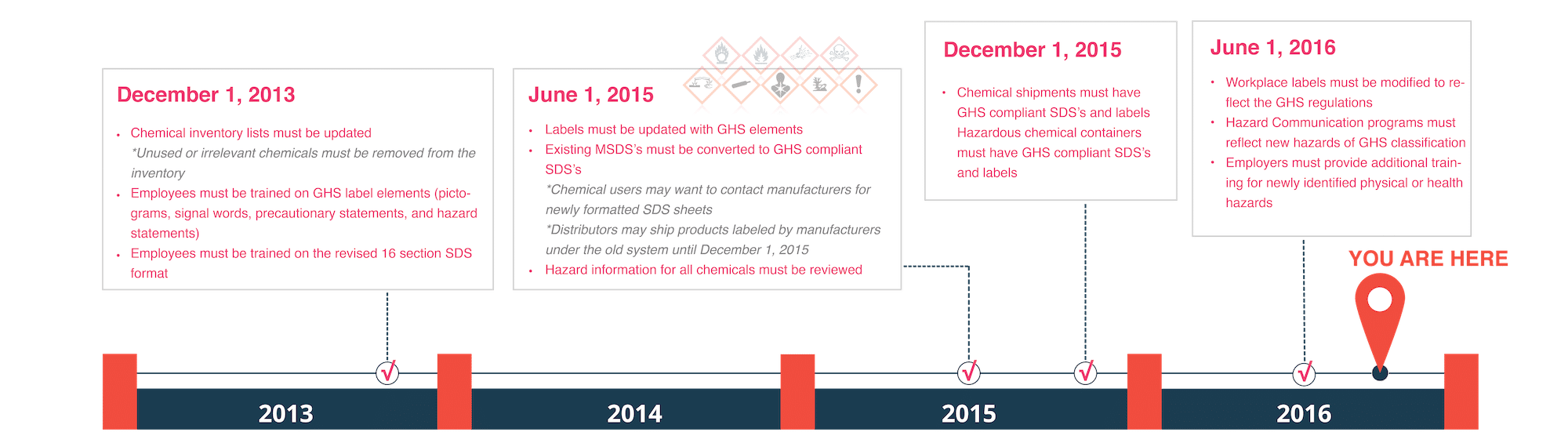
Know your country’s implementation dates as well those in the countries in which you do business. You can find this information here.
GHS, through HazCom, affects any business that manufactures, imports, distributes, or handles hazardous chemicals in the workplace. That’s a broad net: it covers general industry, construction, shipyard, marine terminal, and longshoring employers, and it applies regardless of company size. An employer with a single worker and a single hazardous chemical on site is still covered; there’s no small-business exemption from HazCom.
In practice, this means:
If your operation stores, uses, or ships anything classified as a hazardous chemical under HazCom, which covers a wide range of common industrial and cleaning chemicals, not just exotic ones, GHS applies to you.
While the transition from MSDS to SDS is generally called a “conversion”, GHS requires more than the simple format change. Most new GHS requirements are foreign to most companies, such as new elements and applying GHS classification of chemicals.
Quantum is able to do the hard work for you so that you will be able to meet those standards with precision. To make sure we get everything just right, we developed and used our own software to determine hazard classifications and other elements within the SDS. We check GHS phrases, physical properties, and hazardous statements associated with each chemical product, among many other things. We also offer services such as template customization and regulatory consulting.
A risk assessment is true the day it is written

A worker who refuses an unsafe assignment is protected under

A pre-shift check that records a hydraulic leak and leaves
Thank you for your interest in QSDS! Please fill out the form below to receive an instant quote for your GHS conversion.